The Best AI Tools for Business in 2026
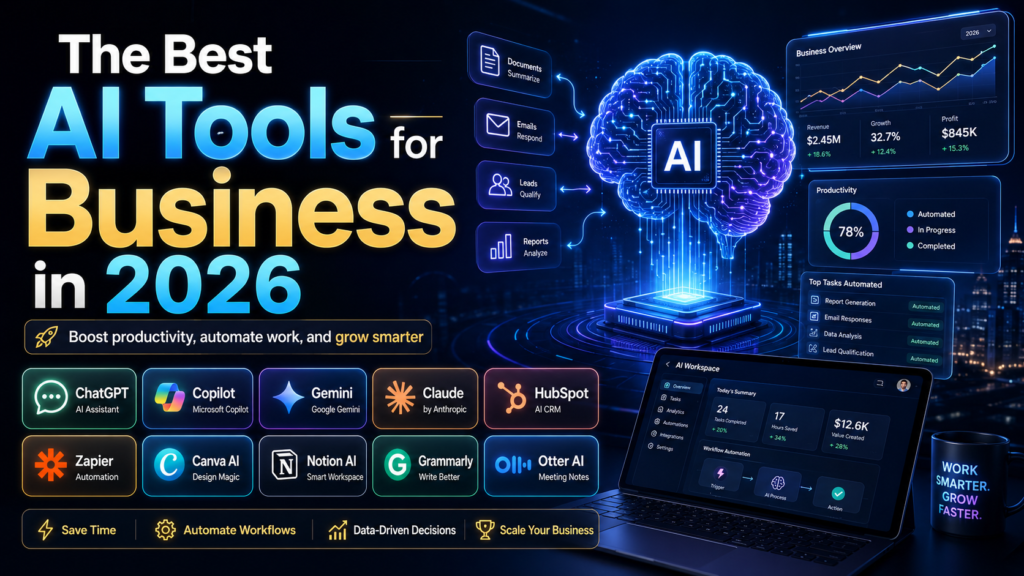
Running a business in 2026 feels very different from running one just a few years ago. Artificial intelligence has become a major part of everyday business operations, helping companies save time, organize information, create content, improve customer communication, and automate repetitive tasks. What makes AI especially interesting today is that it is no longer limited to large technology companies with expensive systems and large technical teams. Small business owners, freelancers, marketing teams, online businesses, and growing companies can now use AI tools to solve real business problems. The challenge, however, is choosing the right tools. There are hundreds of AI platforms available, and almost all of them promise to increase productivity or help businesses grow. The smartest approach is not to use every AI tool you find. Instead, businesses should understand their problems first and choose tools that make their daily work easier. Here are some of the best AI tools businesses should consider using in 2026.
1. ChatGPT Business
ChatGPT has become one of the most popular artificial intelligence tools in the world, and its business uses go far beyond asking simple questions. For businesses, ChatGPT can act as a flexible assistant that helps with writing, brainstorming, research, information analysis, customer communication, and business planning. A business owner can use ChatGPT to turn rough ideas into clear marketing concepts, improve emails, create content ideas, study customer feedback, or organize information from documents. For example, imagine you are preparing a new marketing campaign but you are not sure how to present your product. You can explain your product, your target audience, and your campaign goal, then use ChatGPT to explore different marketing ideas. The most important thing is to remember that AI-generated content should still be reviewed by a human. Businesses should add their real experience, check important information, and make sure the final content matches their brand. ChatGPT is especially valuable because one tool can support many different areas of a business, making it one of the best general AI assistants for companies in 2026.
2. Microsoft 365 Copilot
Microsoft 365 Copilot is a powerful option for companies that already use Microsoft products in their daily work. Many businesses spend hours working with documents, presentations, spreadsheets, emails, and meetings. Copilot brings AI assistance closer to these everyday business activities. Instead of moving information between different platforms, employees can use AI support while working within Microsoft’s ecosystem. This can help businesses understand long documents, summarize important information, develop business content, and work more efficiently with company data. The real problem for many modern businesses is not always a lack of information. In many cases, employees have too much information and not enough time to process it. Copilot can help people move through business information faster and identify important points before making decisions. It is particularly useful for companies already using Microsoft 365 because the AI experience can fit naturally into existing workflows. For office productivity, internal documents, and team collaboration, Microsoft Copilot remains one of the most important business AI tools to watch.
3. Google Workspace with Gemini
Google Workspace with Gemini is another excellent AI solution for businesses, especially companies that already depend on Gmail, Google Docs, Google Sheets, Drive, Meet, and other Google tools. Gemini can help users work with emails, documents, business information, and everyday productivity tasks. For example, a business owner may have hundreds of emails and documents stored across different Google services. Finding the correct information manually can take time. AI can make it easier to search, understand, and organize that information. Gemini can also assist with brainstorming, preparing documents, and understanding complicated subjects. The biggest advantage of using Gemini with Google Workspace is convenience. AI becomes more useful when it is close to the work you are already doing. Instead of constantly copying information from one application to another, employees can use AI support within a familiar environment. Businesses should still verify important information and use human judgment, but Gemini can help teams save time and focus more attention on important decisions.
4. Claude
Claude is another powerful AI assistant that has become increasingly useful for business work. It is particularly interesting for companies working with long documents, detailed written information, analysis, and complex projects. Many businesses collect large amounts of information but struggle to understand or organize it. Customer feedback, reports, internal documents, research, and project notes may contain important insights, but reading everything manually can take hours. Claude can help users explore this information, identify patterns, improve structure, and understand complicated ideas. Writers and marketing teams can also use Claude to review long-form content and identify unclear sections or repeated ideas. Instead of simply asking AI to create everything from the beginning, businesses can use Claude as a thinking partner that helps improve existing work. This approach allows humans to remain responsible for the final decisions while AI supports the difficult process of analyzing and organizing information. Claude is a strong choice for businesses that need an AI tool for thoughtful work, long documents, writing, and analysis.
5. HubSpot Breeze
Marketing and sales teams often need more specialized AI tools. They are not only writing content; they are managing leads, customer information, sales opportunities, marketing campaigns, and customer communication. HubSpot Breeze is designed to support these types of business activities. It can help teams create content, work with customer information, automate certain tasks, and improve marketing and sales workflows. Imagine a company that has created one valuable article or marketing idea. That content may need to become an email, a social media post, and part of a larger campaign. AI can help teams reuse and adapt content more efficiently. The connection between AI and customer information is especially important because businesses need relevant communication, not generic messages. When AI works with the right business context, it can help marketing and sales teams create more useful experiences for customers. HubSpot Breeze is particularly suitable for businesses already using HubSpot and looking for ways to reduce repetitive marketing and CRM work.
6. Zapier
One of the biggest advantages of artificial intelligence is automation, and Zapier is one of the most useful tools for connecting different business applications and automating repetitive workflows. Many companies waste time completing the same small tasks every day. A customer fills out a form, an employee copies the information into another application, a message is sent to the team, and a task is created manually. When this process happens repeatedly, businesses lose valuable time. Zapier can help connect different tools and create automated workflows. For example, information from one application can trigger an action in another system without someone manually copying the data. AI makes these workflows even more interesting because certain information can be processed or organized before the next step happens. However, businesses should not automate every process immediately. The best approach is to first understand the workflow, remove unnecessary steps, and then automate repetitive tasks that genuinely waste time. Zapier is an excellent option for businesses that want to improve efficiency and connect the applications they already use.
7. Canva AI
Visual content is important for almost every modern business. Companies need social media graphics, presentations, advertisements, website visuals, and marketing materials. The problem is that many small businesses do not have a large design department. Canva AI helps make the creative process easier and faster. Business owners and marketing teams can start with an idea and quickly explore different visual directions. A social media manager may need to create several designs for a campaign, while a business owner may need a professional presentation. Canva’s AI features can assist during the creative process and reduce the time required to start from a blank page. However, businesses should be careful not to depend completely on generic AI designs. A strong brand still needs consistent colors, fonts, style, and personality. AI should support creativity, not remove the identity of the business. When used correctly, Canva AI can help companies produce attractive visual content while maintaining a clear brand style.
8. Notion AI
As businesses grow, information can quickly become difficult to manage. Meeting notes may be stored in one place, project plans in another, and important company information may be hidden inside old documents. Employees sometimes spend more time searching for information than actually using it. Notion AI can help businesses organize projects, documents, and internal knowledge inside a connected workspace. When company information is structured correctly, AI-powered search and productivity tools can make that knowledge easier to use. For example, a new employee may have questions about a company process. Instead of asking another employee to explain the same information repeatedly, organized internal documentation can make answers easier to find. Notion AI can also support meeting notes, project planning, and repetitive internal workflows. The important point is that AI works better when the information itself is organized. It cannot magically fix completely chaotic business systems. Businesses should first create clear documentation and then use AI to help teams interact with that information more efficiently.
9. Grammarly
Business communication matters. Employees write emails, sales teams prepare proposals, managers create documents, and marketing teams publish content. A confusing message can create unnecessary problems, while clear communication can improve professional relationships. Grammarly is useful for businesses that want to improve written communication. It can help users identify grammar problems, rewrite unclear sentences, and adjust the tone of a message. This is especially helpful for international teams and people who regularly communicate in English as a second language. A person may understand exactly what they want to say but struggle to make the message sound professional or natural. AI writing assistance can make the communication clearer. Businesses should still avoid making every message sound robotic. Not every sentence needs to be extremely formal. Customer communication may need warmth, while a sales proposal may need confidence. Grammarly is most useful when it helps improve writing while allowing the writer’s natural voice to remain.
10. Otter AI
Meetings create more work than many businesses realize. Someone has to take notes, decisions need to be remembered, and tasks must be identified after the conversation. Sometimes, employees attend an important meeting and later disagree about what was actually decided. Otter AI can help businesses by transcribing meetings, creating summaries, and identifying important action points. This allows team members to pay more attention to the conversation instead of spending the entire meeting writing notes. Meeting information can also become easier to search later. Imagine remembering that a customer mentioned an important requirement several months ago but you cannot remember the exact meeting. Searchable transcripts and summaries can make it easier to find that information. Businesses should, however, use meeting transcription responsibly. Privacy, customer expectations, and employee consent should always be considered when recording conversations. When used correctly, Otter AI can help teams organize meeting information and reduce the amount of manual note-taking.
How to Choose the Right AI Tool for Your Business
The biggest mistake a business can make in 2026 is buying AI tools without understanding the problem they are trying to solve. A company should not subscribe to an application simply because it is popular on social media. The first step is to study the business. Where is the team wasting time? Which tasks are repeated every day? Where are customers waiting too long? What information is difficult to find? Which type of content takes too much time to create? Once these questions are answered, choosing the right AI tool becomes much easier. A business struggling with repetitive workflows may benefit more from Zapier than an AI writing tool. A company that needs better marketing and customer management may prefer HubSpot Breeze. A team working with large documents may find Claude useful, while a business already using Microsoft 365 may benefit more from Copilot.
Businesses also do not need to pay for ten different AI platforms at the same time. Start with one or two tools that solve real problems. Learn how they work, train employees to use them responsibly, and measure whether they actually save time or improve results. If the tool provides real value, continue using it. If it only creates more complexity, the business should reconsider whether it is necessary. Artificial intelligence should simplify work, not make business operations more confusing.
Final Thoughts
Artificial intelligence is changing the way businesses work, but the biggest advantage does not come from using the largest number of AI tools. The real advantage comes from choosing the right technology and using it with a clear purpose. ChatGPT can support general business work, Copilot and Gemini can improve productivity inside familiar business ecosystems, Claude can help with detailed information and analysis, HubSpot Breeze can support marketing and sales teams, and Zapier can automate repetitive workflows. Canva AI helps businesses create visual content, Notion AI supports organization and internal knowledge, Grammarly improves communication, and Otter AI makes meeting information easier to manage.
AI can help businesses save time, improve productivity, and work more efficiently, but human judgment remains important. Business owners and employees still need to understand customers, make difficult decisions, develop creative ideas, and take responsibility for the final result. The best businesses in 2026 will not simply use AI because it is popular. They will use artificial intelligence intelligently, responsibly, and strategically. Start with a real business problem, choose the right tool, and use AI to make your work simpler, faster, and more effective.